SEOdin: How the one-eyed god of ranking came to be
Odin might be a myth, but SEO audits shouldn’t be...
TL;DROn-page SEO audits in a Chrome side panel - one click, zero paid APIs. No private indexes, no black-box scores, just plain math on what the page actually serves. One true thing over a hundred faked ones.
Stack
Full list of features
- Overview + score
- Deep scan
- Time machine
- Since-last-scan diff
- Content & keywords
- LLM readability
- Headings
- E-E-A-T
- Indexing & meta
- Schema linter
- Server view
- Links
- Images
- Social
- Core Web Vitals
- PageSpeed / CrUX
- Accessibility
- SERP X-Ray
- Competitor gap
- Bulk audit
- robots.txt tester
- SERP preview
- Click-to-highlight
- Copy for LLM
Why: Too many SaaS cooks in the SEO kitchen
There are few things I get giddy about as much as I do about mythology. First, it was because these stories featured all sorts of cool beasts, creations, and events, but as I got older, I realized the message behind them made them even cooler.
One of my favorite myths was thus the one about how the Norse god Odin lost his eye. He willingly gave his eye to the all-knowing shadowy being Mimir in exchange for a drink from the well of wisdom, allowing him to gain new perception. Odin chose to see less in order to know more, and I feel like it’s a lesson all SEOs and content marketers should follow. Although, sadly, we don’t get to enjoy the cool fun stuff, like fighting giants or Loki.
Why am I saying this? Well, most SEO tools run on private indexes, proprietary algorithms, formulas you never get to see. You don't actually know what's under the hood, since all you’re seeing is a scale between two numbers, inherently forcing you to abide by someone’s index in order to amass good boy points on a dashboard.
As a result, any SEO who knows their chops ends up comparing providers and their numbers, but is clicking Ctrl + Tab all day something you really want?
At some point you have to stop and ask: are we really spending a thousand a month on subscriptions that all do roughly the same thing, don't talk to each other, and don't give an SEO any actual ease of use? We already live in a thousand tabs - comparing pages, cross-checking findings. Do we really need more tabs, more consoles open shrinking the viewport, more Screaming Frog for every little thing? It's a Pandora's box that we won’t find the lid to once we open it.
If that subscription stack sounds uncomfortably familiar, I can help you close a few tabs.
LET'S TALK →Auditing a page isn’t rocket science - why are you treating it as such?
Data about specific pages is everywhere; it’s even congregated decently well, but there’s one main issue - it’s not really user-friendly. HTML is supposed to be read by machines, not by humans, so manually sifting through everything and putting it in context is a task even Tantalus would be lucky not to experience.
As a result, basic checks cost money or time to untangle, even with AI, and there's nothing ready-made that just does them. Instead, there are too many random charts, scales, and ratings.
That's where SEOdin came from: not a SaaS, not another website, not a widget you have to set up. It’s a simple sidebar plugin you flip on the moment you need it and dismiss when you don't, meant to be accessible regardless of experience level.
I’d say that’s what also ticked me about most SEO tools: UX rarely seems to be a priority. Everyone assumes you want to sit and stare at endless sheets and decipher them. I disagree - the tool should be inclusive, allowing even non-math-inclined people to know the health of a page without feeling like they’re deciphering Linear A.
What am I aiming for, then?
The honest answer to "where does the truth come from, then" is that you don't need their private indexes at all. You read what the page itself serves and what the CDN serves, and you lean on what's genuinely public and free: the Internet Archive, the browser's own performance data and schema to pinpoint what’s going on.
That's enough to actually help an SEO, without ballooning the whole thing into the bloated, stitched-together mess I was trying to get away from in the first place. Curiously, I understood how Odin felt giving up his eye because I was slapping my hand away every time I wanted to add an ultra mode with APIs. Go figure.
But it’s best that I didn’t because SEOdin is made so that it doesn’t tell lies, which is really the whole spine of it. I dabbled in local SEO projects recently, and it's one of the places the big tools fall apart faster than inanimate objects when faced with inebriated Knicks fans. Ahrefs barely estimates a small, regional, but genuinely successful and monetizable site correctly. If you can't even trust it for basic competitor analysis, what are you actually paying for?
So I built the opposite instinct in. You can use every single thing publicly available, with the added benefit of Google’s Nano model running fully locally for a few drafting tasks. Everything is plainly obvious, noticeable, and understandable, and I did it without trying to be Paul Erdos and invent new formulas.
It would be a bit rich to preach transparency and then keep the code to myself.
SEODIN ON GITHUB →And once you pour every ingredient into the cauldron and let the concoction brew for a while, you get an easy way to instantly dissect any page on the web. But then I realized I didn’t hear the ref stop the match and that the whole “accessibility” argument will fall on dead ears if the frontend looked like a junkyard after a thunderstorm.
Turning a junkyard into Optimus Prime
To whip SEOdin into shape, I fortunately didn’t need to forge it with Thor’s hammer. Three volunteer testers were all I needed to determine the following:
- Problematic things must always go first
- Scrolling is trolling
- Colors are your friends; monochromatic is monotonous
- Proper reports are 50% of the job
- Anything beyond local storage would be ludicrous
- Three clicks or bust
Since I already had the clay and now the mold was in my hands as well, it was time to see how to help our patient. The initial diagnosis was far from ideal: the first version had sixteen tabs, because I wanted everything accessible at once, which was frankly Biblical levels of greed.
What's the point if the one problem that matters is buried in tab five or thirteen and you have to go hunting for it?
So now the moment you open SEOdin, you see the overview and the critical issues, colored in a hue of red that’s just annoying enough to pester you into fixing things. Likewise, I made it so every tab flags its own problems so you can see what's broken at a glance, and the overview has a deeper scan that you can use as a starting point.
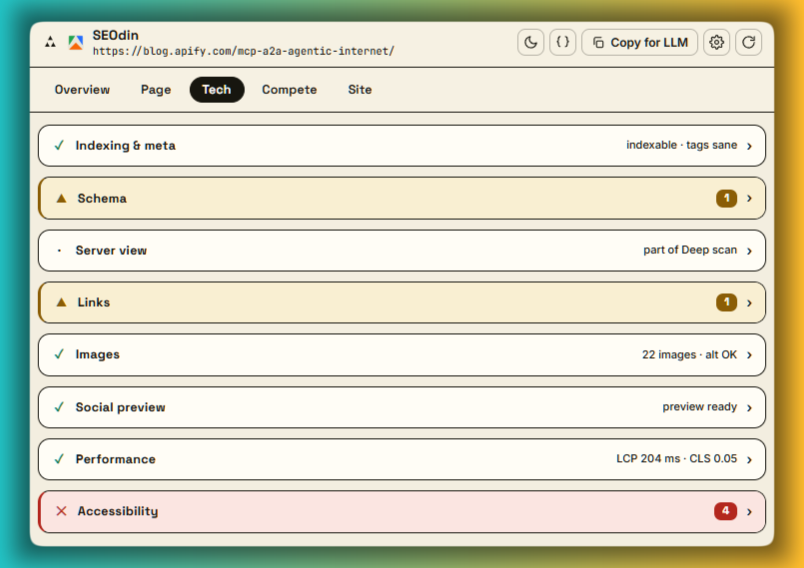
But that was just the beginning: I realized SEOdin could use some more weaponry to make its arsenal truly capable of handling the battles it was built to face.
Am I done? Of course not.
And yes, I know what you’re thinking - "Why no AI in the scores?" I love using AI, but ethically and with a point. So I made one rule: no model ever sets a score or a verdict in SEOdin. The numbers are plain, transparent math you can check.
We're all sick of 17 sources of truth, and a black-box AI estimate would just be an 18th. Where AI does earn its place, it's two optional buttons running Chrome's on-device Gemini Nano that draft a meta description and suggest keywords, clearly labeled as drafts. Remove them tomorrow and 99% of SEOdin works exactly the same.
But still, I want users to take the report as scaffolding for their next steps, so an LLM export button that lets you take it to any provider, harness or chat interface you prefer.
In addition, I’d highlight:
The ability to bulk-audit. In case you want a click glance at multiple pages from a site (or different sites), you can dump up to 30 links to analyze the raw HTML and conduct a cross-page comparison.
Crawling up to 15 other pages on a website. Similar to the above feature, this one expands the scope of the analysis to get a clearer picture, but focused on the same website. Ready for eavesdropping on the competition.
Server view. Fetches a fresh URL from the server and does a raw vs. rendered comparison, along with listing other key metrics.
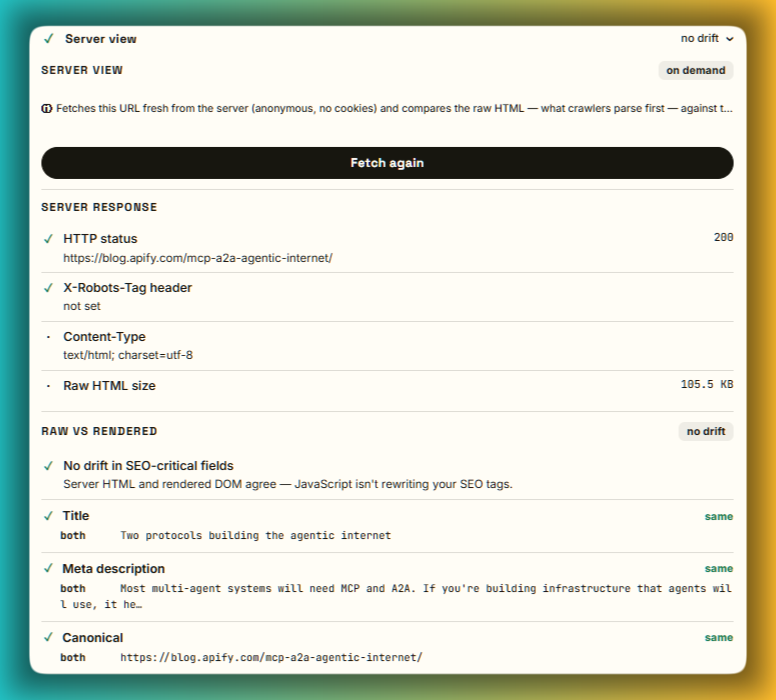
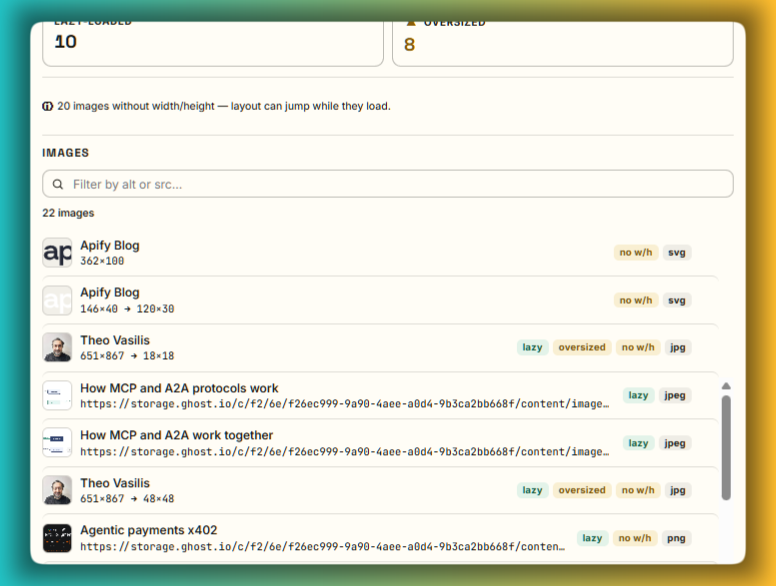
Image analysis. Lists all the images and flags issues with dimensions, sizes, lazy loading, lack of alt text, and more.
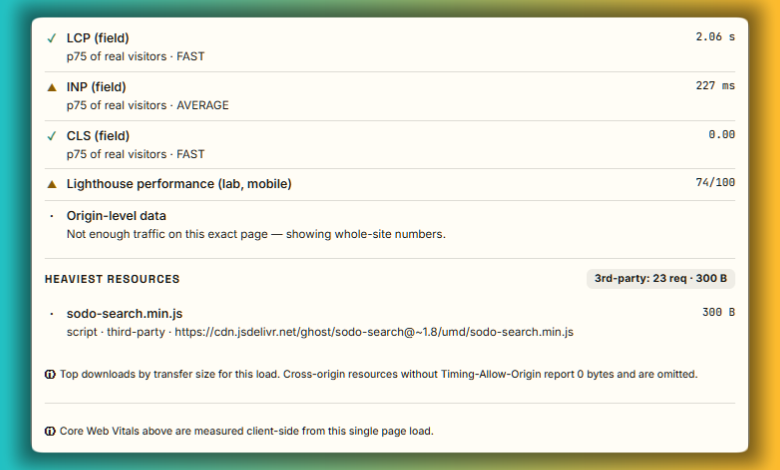
Google PageSpeed Insights report. Real-world data on how the page actually loads for visitors. It runs off Google's free public endpoint, and since Google's anonymous quota is basically dead now, you paste your own free key once - it stays on your machine. Still free, still local, no subscription.
I like to think SEOdin gives up the flattering lies of proprietary black-box metrics and, in exchange, it helps us see honestly. The sacrifice Odin made in the myth maps exactly onto the one decision the whole tool is built around: it would rather show you one true thing than a hundred faked ones.
Want a second pair of eyes on your site - one I didn’t have to trade to Mimir?
LET'S TALK →